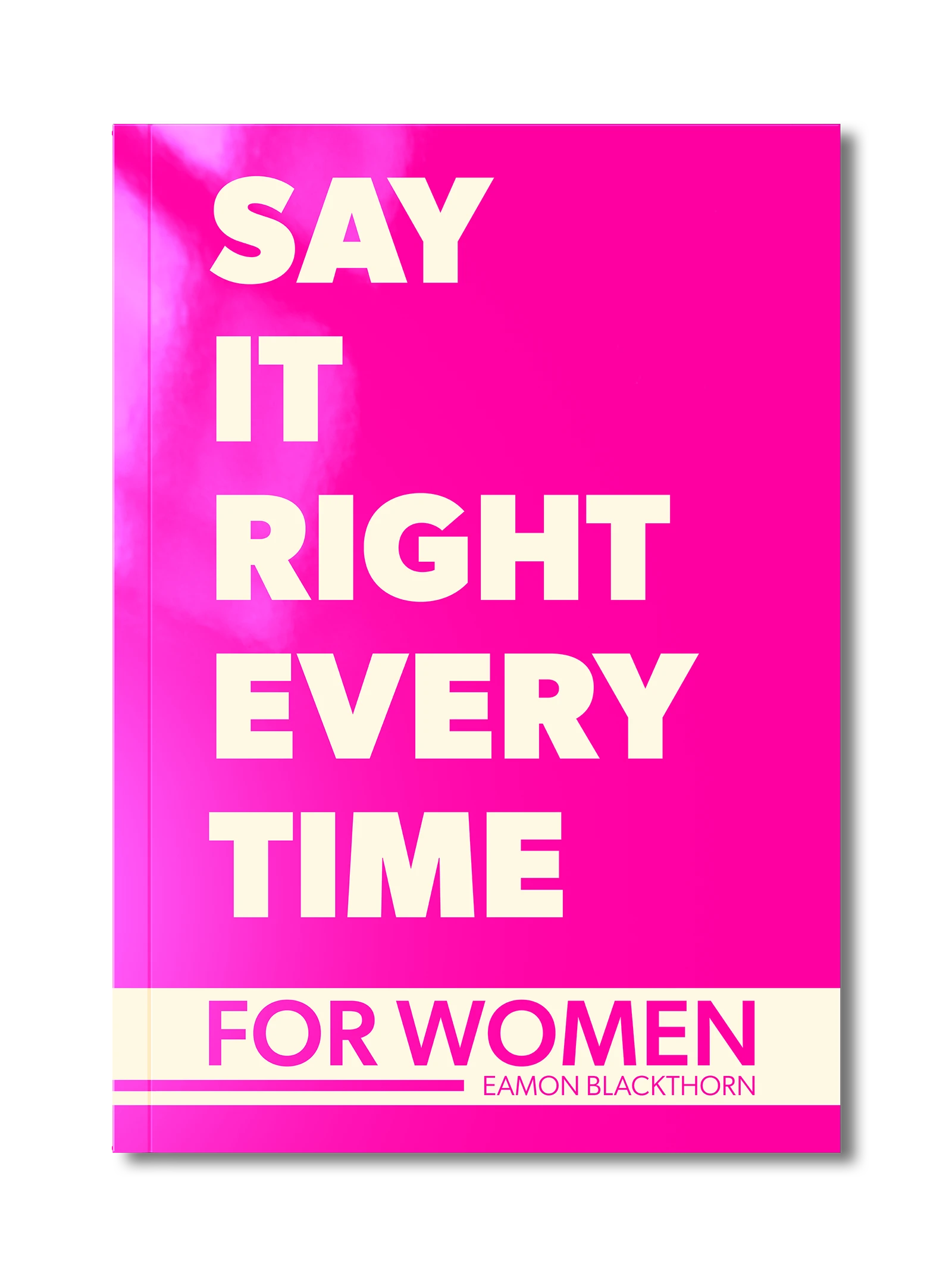
A practical, no-fluff guide to navigating the conversations most people avoid — from tough feedback at work to family disagreements at home. Packed with proven frameworks, real-world scripts, and exercises you can use immediately.
Start Speaking with Confidence When It Matters Most.
You know the feeling. You plan every word perfectly in your head. You picture how the conversation will go — calm, precise, confident.
Then it happens. The moment arrives. And suddenly… your words vanish. You freeze, stumble, ramble. And when it’s over, you replay it all night, wishing you had said what you really meant.
This book changes that.
What Makes Say It Right Every Time Different
Most communication books teach theory — the “why.” This one gives you the exact words.
Inside, you’ll find 115 word-for-word scripts you can start using today — complete conversations for the moments that actually matter:
Asking for a raise without sounding greedy.
Giving feedback without crushing anyone’s spirit.
Setting a boundary without guilt.
Repairing trust after a fight or a mistake.
Each script comes with step-by-step guidance — context, exact phrasing, what to say next, and how to recover if things go off track. It’s not abstract advice — it’s a practical toolkit for real relationships at work, at home, and everywhere in between.
This Book Is for You If…
You replay conversations in your head, wishing you’d said it differently.
You avoid difficult talks until they explode.
You crave actionable phrases, not just theory.
You want to express truth with confidence, clarity, and respect.
Master Every Kind of Conversation
At Work: Negotiate salaries, navigate performance reviews, give and receive feedback, handle tough talks with confidence.
At Home: Talk about money, intimacy, or boundaries without conflict.
With Friends: Say the honest thing without losing the friendship.
Advanced Skills: Manage emotional triggers, recover from mistakes, and stay calm under pressure.
The Frameworks Inside
Every script is built on proven communication models that make saying the right thing simple, even under stress. You’ll discover how to use each one in real conversations:
B.O.U.N.D.A.R.Y. Method — Set limits while keeping connection and respect intact.
B.R.I.D.G.E. Method — Rebuild trust and understanding in tense moments.
C.O.N.N.E.C.T. Method — Deepen empathy and make others feel truly heard.
C.O.R.E. Framework — Clarify your intention before you speak.
C.O.U.R.A.G.E. Method — Find your voice when fear or tension rises.
D.E.A.L. Method — Resolve conflicts without blame or avoidance.
F.A.M.I.L.Y. Method — Bring calm and compassion into family communication.
F.R.I.E.N.D. Method — Strengthen friendships through honesty and care.
G.R.O.W. Method — Lead goal-oriented conversations that inspire progress.
H.E.A.R.T. Method — Use emotional intelligence to de-escalate and connect.
L.E.A.D. Method — Communicate authority with empathy and clarity.
M.A.S.T.E.R. Method — Navigate complex conversations step by step.
R.E.C.O.V.E.R. Method — Rebuild trust after conflict or mistakes.
S.B.I. Method — Give feedback that’s objective, specific, and kind.
S.T.R.O.N.G. Method — Stay grounded in high-stakes or emotional situations.
V.A.L.U.E. Method — Express appreciation and recognition effectively.
Designed for Real-Life Change
This isn’t about perfection — it’s about preparation.
In 60 days, you’ll not only know what to say, you’ll believe you can say it.
Whether you’re facing your boss, your partner, or your own self-doubt, Say It Right Every Time gives you the words, frameworks, and confidence to handle any conversation — and finally mean what you say.
Practical Frameworks. Real Scripts. Immediate Results.
Stop replaying the past. Start saying what counts — when it counts.
Author Eamon Blackthorn holds up a copy of Say It Right Every Time during a live audience presentation. The black-and-white shot captures the intimate atmosphere of the event, with attendees seated closely and taking notes. Author Eamon Blackthorn commands a full auditorium, moving across the stage with microphone raised and his book Say It Right Every Time in hand. The wide black-and-white shot captures the scale of the event and the rapt attention of the crowd filling Author Eamon Blackthorn lifts his book toward a packed, applauding crowd in a powerful closing moment. Shot from behind the stage, the image frames the audience's enthusiastic reaction against dramatic overhead lighting. Author Eamon Blackthorn addresses a large professional audience, microphone in hand and his book Say It Right Every Time tucked under his arm. The close-up black-and-white shot highlights his presence and the engaged crowd behind him.
Videos
Cinematic spotlight teaser for Say It Right Every Time by Eamon Blackthorn.
What exactly is in this book — is it more theory or practical tools?
It's 70% practical tools and 30% essential psychology. The heart of the book is 115 word-for-word scripts covering nearly every difficult conversation you'll face — at work, at home, and in your social life. Each script includes context, exact phrasing, what to say next, and how to recover if things go off track. The psychology is there to explain why the scripts work, so you can adapt them over time and make them your own.
I've read communication books before and they didn't help. How is this different?
Most communication books give you theory — the what and the why — but leave you without the how. This book gives you the exact words to say. Rather than abstract advice like "be more confident" or "be a better listener," you'll find complete, ready-to-use scripts for specific, real-life situations. It's built for the moment when your mind goes blank and you need something concrete to hold onto.
Do I need to read this book cover to cover, or can I go straight to what I need?
You can do both. The book is designed for two types of readers. If you have a difficult conversation coming up tomorrow, go straight to the Master Index at the back — it gives you instant access to all 115 scripts and 16 frameworks organized by situation. If you want to build lasting communication skills from the ground up, read it cover to cover and follow the 60-Day Transformation Plan in Chapter 12.
Will the scripts sound natural, or will I come across as scripted and robotic?
The scripts are your starting point, not a straitjacket. Each one comes in three variations — formal, standard, and casual — so you can choose the tone that fits your voice and relationship. The goal is for the words to sound like you, but a more prepared, more confident version of you. With a little practice out loud, they become genuinely natural.
I'm not someone who struggles at work — I need help with personal conversations. Is this book for me?
Absolutely. Three full chapters are dedicated entirely to personal conversations — romantic relationships, family dynamics, and friendships. You'll find scripts for talking about money and intimacy with a partner, setting boundaries with family members, and having honest conversations with friends without damaging the relationship. These are often the hardest conversations of all, and they're covered in depth.
What are the 16 frameworks, and do I need to memorize all of them?
The 16 frameworks are memorable, acronym-based models — like C.O.R.E., B.O.U.N.D.A.R.Y., and H.E.A.R.T. — that give you a mental structure to follow when a conversation takes an unexpected turn and you don't have a specific script handy. You don't need to memorize all of them at once. The book recommends starting with the C.O.R.E. framework, which underpins everything else, and building from there as you work through each chapter.
I tend to freeze under pressure. Will this actually help in the moment?
Yes — and this is exactly what the book was written for. Freezing under pressure is a biological response, not a personal failing. When stress hits, the rational part of your brain gets hijacked by your survival instincts. The scripts and frameworks in this book act as an anchor in that moment. Because you've practiced them in advance, they're accessible even when you're nervous. The book also walks you through why this happens and how to manage it.
How long does the 60-Day Transformation Plan take each day?
It's designed to be realistic and sustainable — not a second job. The daily practice exercises are short, focused, and build progressively week by week. You don't need to overhaul your schedule. You need consistent, intentional practice. Think of it less like a course and more like a daily habit that compounds over time.
Is this book relevant if I'm not in a senior or leadership role?
Completely. The workplace chapters cover everything from negotiating a raise to handling a difficult colleague to giving feedback upward to a manager. You don't need to be a leader to benefit — in fact, many readers find the book most valuable early in their careers, when the stakes of every conversation feel especially high and the cost of fumbling them is most acute.
What if the other person doesn't respond the way the script anticipates?
Every script includes a section on handling common obstacles — the unexpected responses, the defensiveness, the subject changes. The frameworks are specifically designed for moments when a conversation goes off-script. You're not just memorizing lines; you're building a flexible toolkit for dynamic, unpredictable human conversations.
I've been told I'm "too aggressive" in conversations. Will this book help me find a better balance?
Yes. The book directly addresses this — finding the middle ground between being too passive (avoiding the conversation entirely) and too aggressive (forcing an outcome). The scripts and frameworks are built around clarity, respect, and connection. The goal is never to win a conversation, but to navigate it in a way that's honest, grounded, and productive for both people.
Can I use this book if English isn't my first language?
Yes. The scripts are written in clear, accessible language — no jargon, no complex vocabulary. The three tone variations (formal, standard, and casual) also make it easier to find phrasing that feels comfortable. Many readers who use English professionally but not as their native language find the word-for-word scripts especially helpful, because they remove the added pressure of having to construct sentences under stress.
Who wrote this book, and what makes Eamon Blackthorn qualified to teach this?
Eamon Blackthorn is a 60-year-old man from Northern Ireland who spent decades learning these lessons the hard way — through career setbacks, relationship challenges, and real-life consequences. He's not an academic or a theorist. His experience spans factory floors, boardrooms, kitchen tables, and everything in between. The book is built on hard-won, practical wisdom that has been tested in real situations, not developed in a classroom.
Will this book help with conversations I've been avoiding for months — or even years?
That's exactly what it's designed for. The book opens by acknowledging that 85% of professionals admit to avoiding difficult conversations, and it addresses head-on why avoidance feels safer but costs so much more in the long run. You'll find specific scripts for re-opening old, unresolved conversations — whether with a boss, a partner, a parent, or a friend — and guidance on how to approach them without making things worse.
What's the single most important thing I'll take away from this book?
The confidence that you always have something to say. Right now, the fear in difficult conversations comes partly from not knowing what words to reach for. This book gives you a deep, well-practiced library of language for the moments that matter most. Over time, the scripts become second nature — and the frameworks give you a reliable foundation even in conversations you've never faced before. You stop dreading these moments and start feeling ready for them.
4.8
★★★★★
712369 Reviews · 343 Ratings
5★
88%
4★
7%
3★
2%
2★
2%
1★
1%
369 Reviews + 343 Ratings
★★★★★
Alicia Hammond✓ Verified Purchase
Used Script 104 and it actually worked
Ending a friendship is one of the most uncomfortable things an adult can do, and every piece of advice I had ever read just said don't ghost them, have the conversation, without explaining how. Script 104 for ending a friendship gracefully gave me the actual words. The F.R.I.E.N.D. method helped me frame it with care, acknowledge the history of the friendship, and express honestly why I needed to step back. The other person was sad but not blindsided. No drama. That outcome would not have happened without this book.
Helpful?
293
Eamon BlackthornAuthor
Author of the best-selling bookSay It Right Every Time
That conversation takes real courage, Alicia. Most people choose the slow ghost because the explicit ending feels crueler. In my experience the opposite is usually true: the slow ghost takes longer and leaves the other person more confused. You gave your friend something most people never get: a reason.
Helpful?
311
★★★★★
J.R. (Hijo)
Chapter 9 is the book's hidden gem
Most communication books treat family conversations as an afterthought. Chapter 9 does not. Blackthorn identifies three specific factors that make family conversations uniquely difficult: shared history (every conversation is layered with decades of experience), emotional intensity (the people who love us most can hurt us most), and unspoken expectations. That taxonomy alone is worth reading.
The B.O.U.N.D.A.R.Y. method for setting limits with family is the most detailed and nuanced of all the frameworks in the book. The step about understanding their reaction rather than simply steamrolling past it reflects an emotional sophistication that a lot of boundary-setting advice lacks.
Helpful?
289
Eamon BlackthornAuthor
Author of the best-selling bookSay It Right Every Time
Family conversations are the ones I was most nervous to include because the stakes feel so different. What I kept coming back to is that the skills are transferable even when the relationships are not comparable. The difference is the layers, and the B.O.U.N.D.A.R.Y. method tries to honour that by building in more checkpoints than the other frameworks. Glad it landed for you.
Helpful?
307
★★★★★
Christine Fields
This came at exactly the right time
I was three weeks into a new team lead role and struggling with a conflict between two team members that was getting worse fast. The D.E.A.L. method gave me a structure for a conversation I had been avoiding. The step about agreeing on a single neutral problem statement before anything else was the key. The conversation took ninety minutes and we left with a written agreement and a follow-up checkpoint scheduled. Four weeks later both team members are working well together. This book arrived at exactly the moment I needed it.
Helpful?
286
Eamon BlackthornAuthor
Author of the best-selling bookSay It Right Every Time
A written agreement and a follow-up checkpoint: those are the two steps most people skip, and they are the ones that determine whether the resolution holds. I learned that the hard way years ago when I mediated a conflict, shook hands, and called it done. Six weeks later it had unravelled completely because no one had committed to anything concrete. The lock-in step in D.E.A.L. is not a formality; it is the whole thing.
Helpful?
320
★★★★★
Jake Patterson
Used Script 14 and got the raise
My manager approved my raise request on the first conversation after I prepared using Script 14 and the V.A.L.U.E. framework. I had tried twice before with no success. The difference was framing it as a business case rather than a personal need, which is exactly what the book teaches. Practical and it works.
Helpful?
273
Eamon BlackthornAuthor
Author of the best-selling bookSay It Right Every Time
That is exactly the shift, Jake. A raise conversation that sounds like a plea puts the other person in an awkward position. A business case gives them a reason to say yes. Glad it worked out.
Helpful?
281
★★★★★
Sandy
Script 29 for upward feedback fills a gap everyone feels but nobody addresses
Upward feedback is the most avoided conversation in most workplaces and most resources are written entirely from the manager's perspective. Script 29 gives everyone else language that is honest without being insubordinate and specific without being accusatory. I used it after a meeting where my director had publicly undermined a decision our team had made together. The conversation was uncomfortable, necessary, and better than anything I could have built on my own.
Helpful?
270
Eamon BlackthornAuthor
Author of the best-selling bookSay It Right Every Time
Upward feedback is the most needed and most avoided conversation in most workplaces. The gap between knowing something is wrong and being willing to say so to the person above you is enormous, and most organizations quietly punish the people who close it. Script 29 exists because that gap has a cost and it is usually paid by the people who stay quiet.
Helpful?
319
★★★★★
Asha Williams
The Empathy Bridge is the most useful single technique in the book
The Empathy Bridge, the instruction to connect before you correct and acknowledge before you deliver, is the technique I have returned to most consistently since finishing this book. It solves the problem that most feedback and difficult conversation training misses: the other person's nervous system has to be settled enough to hear you before they can process what you are saying. The technique does not require a long preamble; even one sentence of genuine acknowledgment before your message changes the temperature of the conversation. I have tested this in feedback conversations, boundary-setting, and one particularly difficult conversation with a family member. It works consistently.
Helpful?
267
Eamon BlackthornAuthor
Author of the best-selling bookSay It Right Every Time
The Empathy Bridge works because it addresses a physiological reality before it becomes a communication problem. When someone senses a difficult message coming, their amygdala starts preparing for threat before you have said a word. The acknowledgment is not just a social grace; it is a signal to the nervous system that this is a safe conversation. That signal is what allows everything that follows to land.
Helpful?
291
★★★★★
Diane the princess
The conversation pre-mortem finally gave my anxiety somewhere useful to go
For years I had been spending two or three days before important conversations imagining everything that could go wrong. The book names this in Chapter 1: 67 percent of professionals lose sleep over conversations they need to have. What it adds is the pre-mortem technique: think through the worst realistic outcome deliberately, assess how likely it actually is, and plan your response. Finishing the thought is where the fear loses its hold. I had been doing the first half of that process without ever completing it. That incompletion was where all the anxiety lived.
Helpful?
257
Eamon BlackthornAuthor
Author of the best-selling bookSay It Right Every Time
That incompletion is exactly where the anxiety lives, Diane. The mind keeps returning to the worst case because it has not resolved what to do about it. The pre-mortem asks you to stay in the discomfort long enough to make a plan. Once the plan exists, the loop closes. I am curious: when you worked through it, did the worst realistic outcome turn out to be more survivable than you had expected?
Helpful?
302
★★★★★
Brian Foster✓ Verified Purchase
The B.R.I.D.G.E. method repaired a relationship I had written off
I had a falling out with a colleague two years ago that damaged our working relationship to the point where we were barely communicating beyond the minimum required. I had written it off as unsalvageable.
The B.R.I.D.G.E. method for rebuilding relationships after conflict gave me a structure I had not considered: begin with an apology even if only ten percent to blame, reaffirm the relationship, identify what broke down, discuss new expectations, gain explicit agreement, and set a follow-up checkpoint. I asked for a coffee meeting and worked through it step by step.
The most important element was the step about identifying the breakdown in the process rather than the breakdown in the person. We had argued about a project decision, not about each other, but it had been treated as a personal failure by both of us. Naming the process was the thing that unlocked it.
Helpful?
251
Eamon BlackthornAuthor
Author of the best-selling bookSay It Right Every Time
That instinct to treat a process disagreement as a personal failure is one of the most common roots of lasting workplace conflict, Brian. I have seen teams fall apart over a single project decision that both parties took personally when neither intended it that way. The reason B.R.I.D.G.E. starts with an apology even when you are only ten percent to blame is that ownership of any part of the breakdown signals you are there to repair, not to re-argue. Once the other person sees that, they usually meet you where you are.
Helpful?
265
★★★★★
Derek W.
The D.E.A.L. method saved a working relationship
Two senior developers on my team had been in a cold war for most of last year. Every meeting between them was tense and the rest of the team was starting to feel it. I read the chapter on conflict resolution and used the D.E.A.L. method: defined the issue in a single neutral statement, gave each person equal uninterrupted time to explore their perspective, then worked toward an agreement rather than a verdict.
The conversation took two hours. The author's framing from the Two Dragons story in Chapter 6 held me steady: conflict is not a sign of dysfunction, it is often a sign of people who care. Three weeks later both developers are working productively again. This one chapter alone justified the price.
Helpful?
242
Eamon BlackthornAuthor
Author of the best-selling bookSay It Right Every Time
That two-hour conversation took real nerve, Derek. I've sat in rooms like that and the temptation to smooth things over with a vague agreement is enormous. The reason D.E.A.L. works is that it forces you to define the issue before proposing a solution. Most conflict conversations fail because both sides are arguing about different things without realising it. It sounds like you held the structure when it mattered.
Helpful?
256
★★★★★
DevTeamLead
D.E.A.L. resolved a team conflict I had been avoiding for months
Two engineers on my team had been in a cold war for seven months and it was starting to affect everyone around them. I used the D.E.A.L. method from Chapter 6: got both of them to agree on a single neutral problem statement before anything else, gave each person equal uninterrupted time, and wrote down the commitment at the end. The agreement held. The lock-in-the-commitment step is the one most people skip and it determines whether anything actually changes.
Helpful?
231
Eamon BlackthornAuthor
Author of the best-selling bookSay It Right Every Time
Seven months is a long time for a team to carry that weight. The lock-in step is where most mediations fall apart. I learned this the hard way: I once ended a conflict conversation with a handshake and called it done. Six weeks later it had completely unravelled because nobody had committed to anything specific. The written commitment is not a formality; it is the whole thing.
Helpful?
254
★★★★★
David Martinez Junior
This book helped me save a 15-year friendship
The author opens Chapter 10 with a story about losing a 15-year friendship not because of what he said, but because of what he didn't say. I was three paragraphs in and already thinking about a friend I had been avoiding a difficult conversation with for nearly two years.
I used the F.R.I.E.N.D. method to structure that conversation: framed it with genuine care, respected our history together, identified the specific issue, expressed how I felt, navigated toward understanding. It did not go perfectly. But it went. And we are still friends.
The line that hit me hardest was this: the conversations you avoid don't preserve the relationship. They erode it. I had been telling myself that staying quiet was protecting us. It wasn't. It was just slower damage.
Helpful?
229
Eamon BlackthornAuthor
Author of the best-selling bookSay It Right Every Time
That line stayed with me for a long time too, David. I learned it the hard way, which is where most real lessons come from. A friendship of fifteen years ended because neither of us was willing to say the uncomfortable thing first. By the time I understood what had happened, it was too late to fix it. I wrote that chapter because I did not want anyone else to find out the same way I did.
Helpful?
269
★★★★★
Rachel Monroe
The conversation that saved a client relationship
A client of mine had been escalating complaints for weeks and I was dreading the next call. I used Script 54 for responding to a complaint from a client and it was the first time in three years of running my own business that a complaint conversation actually ended with the client feeling better about working with me.
The setup instruction to acknowledge the impact before moving to solutions is the part I had always rushed past. Taking sixty seconds to genuinely validate the frustration before explaining anything changed the entire temperature of the conversation. We renewed the contract the following week.
The five-part structure for each script (when to use, setup, the script, follow-up, troubleshooting) is the most practically useful format I have encountered in any resource like this. The troubleshooting section has saved me multiple times.
Helpful?
226
Eamon BlackthornAuthor
Author of the best-selling bookSay It Right Every Time
That contract renewal is the outcome the whole script is built around, Rachel. Most client complaints are not about the problem itself; they are about feeling unheard. When you solve the feeling first, the problem is usually much easier to solve.
Helpful?
275
★★★★★
Aline. Torres
The pre-mortem technique changed my anxiety around hard conversations
The conversation pre-mortem is a simple idea executed precisely: before a difficult conversation, ask what is the worst that could realistically happen, assess how likely it is, and decide what you would do if it did. What I had been doing without knowing it was spending mental energy imagining catastrophe without ever completing the thought. The pre-mortem forces you to finish the loop. The anxiety that was costing me hours of sleep has reduced significantly since I started applying this before any high-stakes conversation. The three fears named in Chapter 1 (unknown, conflict, vulnerability) are precisely the fears I had been unable to name on my own.
Helpful?
225
Eamon BlackthornAuthor
Author of the best-selling bookSay It Right Every Time
The loop completion is exactly right. Anxiety about a conversation tends to live in the space between "what if it goes badly" and refusing to think past that point. The pre-mortem asks you to think past it, and most people discover the worst realistic outcome is survivable. It is not the outcome that paralyses us; it is the ambiguity.
Helpful?
256
★★★★★
Chen
The brag book concept changed how I prepared for my review
The concept of the brag book in Chapter 4, a documented collection of your accomplishments, contributions, and testimonials to support career advancement conversations, is something I had never encountered framed this way. I spent a weekend building one before my annual review using the V.A.L.U.E. method as my structure. The conversation was the most productive career discussion I have had in five years at the same company. The book explicitly advises treating a raise conversation as a business case rather than a personal plea, and the brag book is what makes that possible in practice.
Helpful?
220
Eamon BlackthornAuthor
Author of the best-selling bookSay It Right Every Time
A weekend well spent, S. Chen. Most people walk into raise conversations with vague confidence and specific disappointment. You walked in with evidence. That is a fundamentally different conversation.
Helpful?
264
★★★★★
Christine Britain
The D.E.A.L. method resolved a months-long team conflict
I manage a team of fourteen and had two people in a cold war that had been affecting everyone around them for almost four months. The D.E.A.L. method in Chapter 6 gave me a structure for a mediation I had been avoiding. Getting both of them to agree on a single neutral problem statement before anything else changed the dynamic immediately. They had each been arguing about a slightly different version of the conflict without realizing it. We left with a written agreement and a follow-up checkpoint. Five weeks later the relationship is functional and productive. The lock in the commitment step is the one most people skip and it determines whether the resolution actually holds.
Helpful?
218
Eamon BlackthornAuthor
Author of the best-selling bookSay It Right Every Time
Four months is a long time for a team to carry that weight, Christine. You are right about the lock-in step. I learned its importance the hard way: I mediated a conflict, both parties shook hands, and I called it done. Six weeks later it had unravelled completely because nobody had committed to anything specific. An agreement without a written commitment and a follow-up checkpoint is just a good conversation that has not been tested yet.
Helpful?
251
★★★★★
Vanessa
Script 84 gave me words for a conversation I never thought I could have
There is no script for discussing a betrayal in most communication books. Script 84 and the H.E.A.R.T. method gave me a starting point for one of the hardest conversations of my life. Honoring my partner's perspective before stating my own felt impossible in the moment. It turned out to be the thing that kept the conversation from becoming another argument. We are still working through things. The conversation happened, which is more than I could say before.
Helpful?
197
Eamon BlackthornAuthor
Author of the best-selling bookSay It Right Every Time
The conversation happened. That is the thing. Most of the time what stands between us and the conversation we need to have is not the other person; it is not knowing how to begin. You found a way in. What comes next is hard, but it is navigable because you are now in it together rather than alone with it.
Helpful?
228
★★★★★
Nathan Wells
Pairs well with anything on emotional intelligence
If you have read Goleman or any of the foundational emotional intelligence literature, this book is the natural next step: it gives you the language and scripts to act on what you understand intellectually. The C.O.R.E. framework maps neatly onto the core components of emotional intelligence, which is not a coincidence. What this book adds is the mechanics of execution. The conversation pre-mortem technique is the missing piece I had been looking for: a way to work with worst-case anxiety rather than against it, by completing the thought instead of leaving it hanging. The 60-day transformation plan is also the first structured practice plan I have seen in a communication book that goes beyond a vague suggestion to practice more.
Helpful?
196
Eamon BlackthornAuthor
Author of the best-selling bookSay It Right Every Time
The parallel to emotional intelligence frameworks is intentional, Nathan. Understanding your emotions is not enough if you don't know what to say when they are running high. The pre-mortem works because anxiety about a conversation almost always lives in the space between imagining the worst and refusing to think past it. Finishing the thought is where the fear loses its grip.
Helpful?
237
★★★★★
Lisa
The only communication book that takes saying no seriously
Most communication books mention saying no in passing. This book gives it two separate scripts (Script 8 for confidence building and Script 56 for workplace situations) with full setup, follow-up, and troubleshooting guidance. The psychological grounding is also right: the difficulty of saying no is rooted in the fear of conflict and the fear of damaging the relationship, both of which are named in Chapter 1. Treating boundary-setting as a skill that requires practice rather than a personality trait you either have or do not is one of the most useful reframes in the book.
Helpful?
183
Eamon BlackthornAuthor
Author of the best-selling bookSay It Right Every Time
The two-script treatment was intentional, Lisa. The confidence script addresses the internal barrier; the workplace script addresses the relational one. They are different problems. People who can say no to themselves often still struggle to say it to a demanding colleague because the dynamic is entirely different. Separating them was the honest thing to do.
Helpful?
228
★★★★★
James Webb
The brag book concept changed how I prepared for my annual review
Spending a weekend building the brag book described in Chapter 4, a documented collection of accomplishments, contributions, and testimonials organized using the V.A.L.U.E. method, transformed the annual review conversation that followed. It was the most productive career discussion I have had in five years at the same company. Having evidence changes the conversation from a negotiation to a presentation.
Helpful?
170
Eamon BlackthornAuthor
Author of the best-selling bookSay It Right Every Time
A weekend well spent, Marcus. Most people walk into raise conversations with vague confidence and specific disappointment. You walked in with evidence. That is a fundamentally different conversation, and the other person in the room knows it immediately.
Helpful?
204
★★★★★
Michelle Patterson
The R.E.C.O.V.E.R. method is the missing piece in most training
Most communication training focuses on preventing difficult conversations from going wrong. Almost none of it addresses what to do when they already have.
The R.E.C.O.V.E.R. method (Recognize, End if needed, Cool down, Own your mistakes, Validate their experience, Explain what you meant, Recommit to the relationship) addresses the aftermath directly. The sequencing matters: validating before explaining prevents the explanation from being heard as a defense.
I manage a team of twelve and this has become the framework I reach for when a conversation has gone sideways. The step about ending the conversation if needed, without burning it, is something I had never seen explicitly scripted before. Most people either push through to a bad conclusion or walk away with no plan to return.
Helpful?
161
Eamon BlackthornAuthor
Author of the best-selling bookSay It Right Every Time
The sequencing in R.E.C.O.V.E.R. was one of the harder things to get right, Michelle. In a failed conversation, the natural instinct is to explain first: to correct the misunderstanding, to clarify the intention, to get the record straight. But explanation before validation almost always reads as defensiveness, even when it isn't. When someone feels their experience has been acknowledged, they can actually hear what comes next.