
What Happened
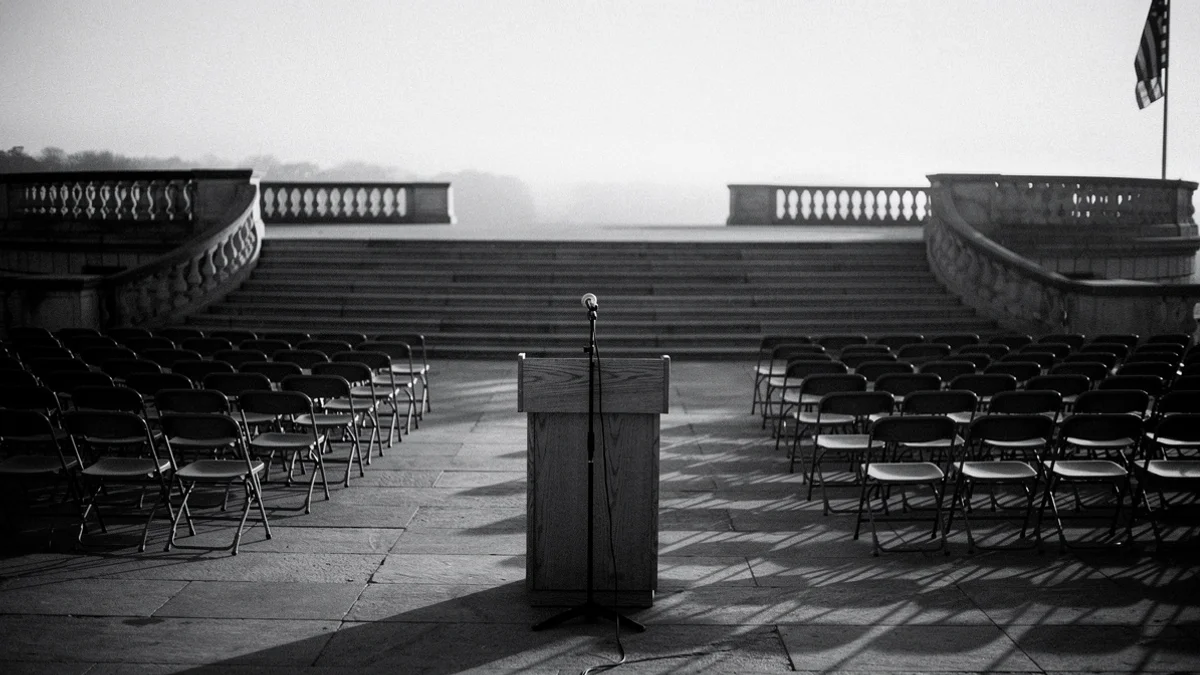
Virginia Governor Abigail Spanberger will take the stage as the featured speaker at Monticello's annual Fourth of July celebration, now in its 64th year. The event doubles as a naturalization ceremony, welcoming new American citizens on the nation's birthday. It is one of the most symbolically loaded speaking opportunities in the state.
The Communication Angle
Most politicians treat public speaking like a scheduling problem. They show up, they say words, they leave. Spanberger's team made a smarter call here, because venue selection is itself a communication act. Monticello is not a generic backdrop. It is Thomas Jefferson's home, the physical birthplace of American idealism, and the site where new citizens take their oaths. Before the Governor says a single word, the setting has already done heavy lifting for her message.
This is called contextual alignment, and it is one of the most underused tools in public communication. When your setting, your occasion, and your message all point in the same direction, your credibility multiplies. A governor speaking about civic values at a Fourth of July naturalization ceremony at Monticello is not just giving a speech. She is inhabiting an argument. The room proves the point before she opens her mouth.
Now here is where most speakers blow it: they treat a ceremonial moment like a campaign stop. They make it about themselves. The audience at a naturalization ceremony is not there for the governor. They are there for the new citizens. The speaker's job in that room is to disappear into the occasion and make the people being honored feel like the center of the universe. Any governor who walks into Monticello on July 4th and spends more than thirty seconds on her own record or agenda has misread the room completely.
The right move is to speak directly to the new citizens. Name the weight of what they did to get there. Acknowledge the distance, the paperwork, the sacrifice. Then connect it to the larger story of the country. That structure, from the specific and personal to the universal, is the blueprint for ceremonial speaking. It works every time because it earns the emotional moment instead of assuming it.
Spanberger also benefits from a built-in advantage: she is a former CIA officer and federal representative. She carries a biography that fits the gravity of the occasion. But biography only matters if you reference it in service of your audience, not in service of your own image. The line between "I understand public service" and "look at my career" is thin, and the best speakers never cross it.
This is exactly the kind of scenario I break down in Say It Right Every Time. The chapter on occasion-driven speaking gives you a framework for reading the room before you write a single word, so you stop treating every speech like a blank canvas and start treating it like a contract with the audience in front of you.

Never Be Lost
for Words Again
Get word‑for‑word scripts for the conversations that shape your life, from job interviews and negotiations to difficult talks with family and partners, so you always know exactly what to say and how to say it.
Never Be Lost
for Words Again
Get word‑for‑word scripts for the conversations that shape your life, from job interviews and negotiations to difficult talks with family and partners, so you always know exactly what to say and how to say it.
Key Takeaway
Before your next ceremonial or keynote speech, write down one sentence that names what the audience is actually there to celebrate. Not what you want to say. What they came to feel. Build your entire opening around that sentence, and save your credentials for a single, brief moment in the middle, never at the start.