
In Short
Funeral icebreakers work when they center on the person who died, not on the speaker. The right opening invites memory, creates safety, and gives grieving people permission to connect. The wrong one creates distance at the exact moment people need the opposite.
Funeral icebreakers are conversation-opening phrases or gestures used at memorials, wakes, and somber gatherings to help mourners connect with one another. They differ from standard icebreakers in tone and purpose: they acknowledge grief, invite shared memory, and create connection without demanding energy or performance.
I watched a man stand alone at the back of a funeral reception for forty minutes because no one knew how to begin. Not because people did not care. Because they were waiting for the right words to arrive on their own. That is when I understood that funeral icebreakers are not a soft skill. They are a form of courage. The right opening phrase at a memorial does not manufacture joy. It creates safety. And without someone willing to take that first small step, the grief in the room stays private, sealed inside each person like stones in a pocket.
What to Notice Before You Say Anything
Before you look at these examples, I want to give you one thing to watch for: where the speaker's attention is pointed.
Every icebreaker that works at a somber gathering points outward, toward the person who died or toward the listener. Every icebreaker that fails points inward, toward the speaker's discomfort, their relationship credentials, or their desire to say the right thing. You will see this pattern repeat across every example below. Once you see it, you cannot unsee it.
This is not about finding perfect words. It is about pointing your attention in the right direction before you open your mouth.
"The Conversation You're Avoiding Is the One You Need to Have."
"The Conversation You're Avoiding
Is the One You Need to Have."
Stop rehearsing conversations you'll never have. Say It Right Every Time gives you 115 word-for-word scripts and 16 proven frameworks to speak with confidence in every conversation that matters.
Example 1: The Colleague Who Got It Right Without Knowing Why
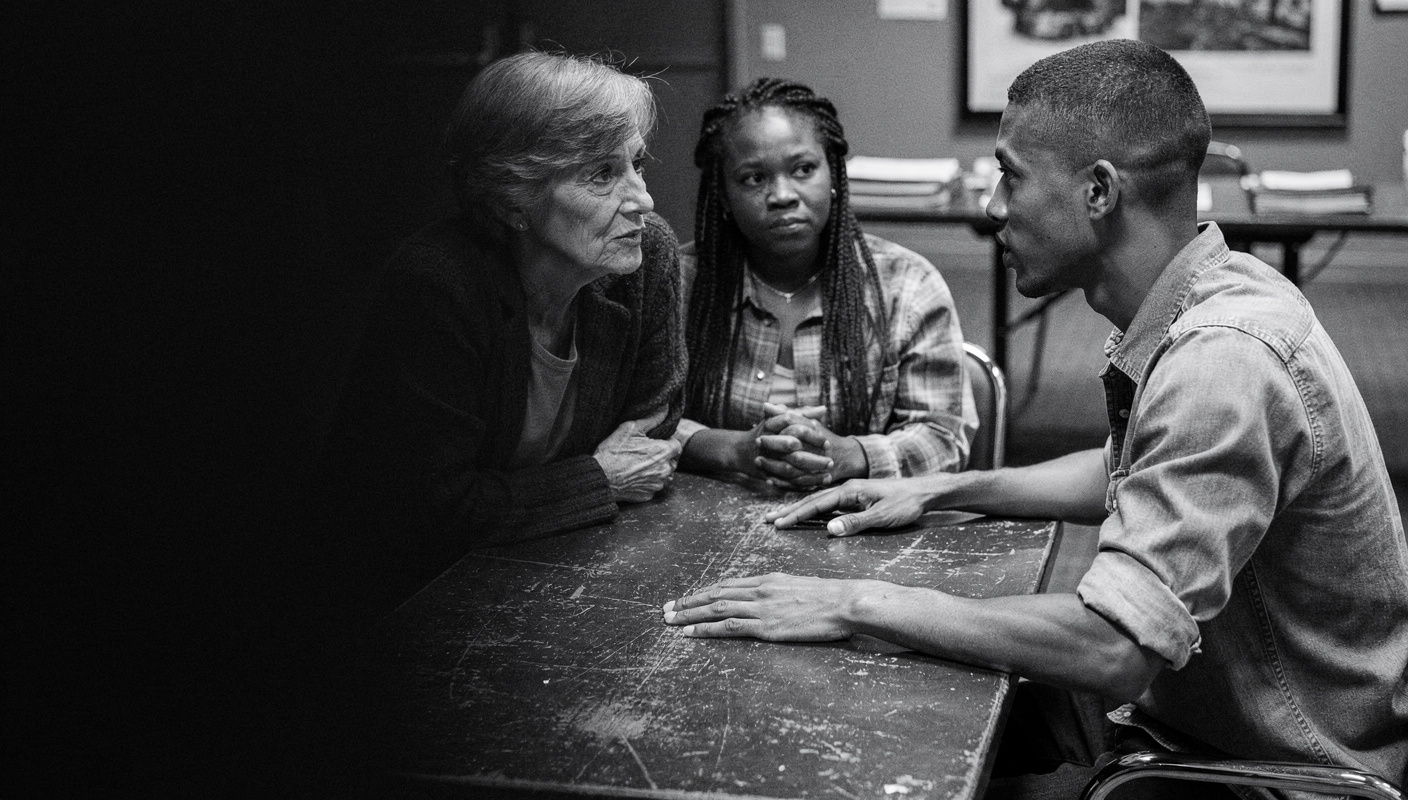
At a memorial for a retired teacher, a former colleague found herself standing near a woman she did not recognise. The silence between them had stretched long enough to become uncomfortable. The colleague said simply: "I keep thinking about the way she used to start every class with a question nobody could answer straight away. Did you ever experience that?"
The stranger's face changed immediately. She had been a student twenty years earlier. They talked for ten minutes.
What made it work had nothing to do with wit or preparation. The colleague pointed her words directly at the woman being remembered, and she made the question easy to answer. There was no pressure to perform emotion, no demand for a story. Just an invitation. A good icebreaker at a funeral does not require the other person to be ready. It simply opens a door and steps back.
Example 2: When the Standard Script Made Things Worse
A well-meaning man at a wake spent the first hour approaching small groups with the same opener: "At least she lived a long and full life." He meant it kindly. He believed it. But one by one, people gave thin smiles and turned away.
This much I know for certain: icebreakers borrowed from a comfort script do not comfort. They close people down. The phrase asked nothing, invited nothing, and left no room for the other person to add their own truth. It also carried a faint suggestion that grief was unnecessary. One woman quietly told her husband afterward that she had felt judged for crying. That was not the man's intention. But intention is not the whole story.
A somber gathering is not a place to resolve grief. It is a place to share it. An icebreaker that pretends the grief is already tidy does the opposite of what the moment needs. For more on how nonverbal communication works in tense situations, the same principle applies: what you do not say carries as much weight as what you do.
Example 3: The Question That Filled a Room
At a small gathering after a musician's funeral, the room had divided into clusters that were not mixing. People knew each other only through him, and without him as a bridge, the connections were strained. One of his oldest friends walked to the centre of the room and said: "I want to hear something. What is the one song of his that you cannot get out of your head today?"
The room shifted. People turned toward each other. A teenager named one song; an elderly man named another and explained why. Someone pulled out a phone and played thirty seconds of a recording. The clusters dissolved.
This is one of the most useful tools I have seen at a memorial: an open question addressed to the room, not to one person. It requires courage to stand up and ask it. But it requires no skill. Any person who loved the deceased can do this, at any gathering, with any variation of that question. The method is simple. The effect is profound. If you want to understand how well-timed questions shift group energy, the same dynamic applies when you are running inclusive meetings with diverse teams: one good question does more than ten prepared statements.
Example 4: The Adult Child Who Could Not Begin
Here is an example where the absence of any icebreaker carried real cost. A woman who had just lost her father stood near the entrance of the reception greeting people as they arrived. She was present. She was composed. But she had no words prepared beyond "thank you for coming," and after two hours of saying only that, she told her sister she felt utterly alone in a room full of people.
No one had offered her a real opening either. People took their cue from her brevity and kept their own words short. The result was a room of sixty people who each grieved separately, together.
A single question from any one of those visitors, something as plain as "Tell me something about him that you want people to know today," would have changed her afternoon. She needed someone to give her permission to speak about her father. Nobody did. This is what an icebreaker costs you when it goes absent: not just awkward silence, but a missed chance to let someone feel held by the people who showed up.
Example 5: The Stranger Who Prepared Three Words
I once spoke with a woman who told me she always arrives at funerals with three things ready: a genuine memory if she has one, a question about how the other person knew the deceased, and the phrase "I am so glad they had you." She is not a counsellor or a trained communicator. She is a retired nurse who decided forty years ago to stop waiting for the right moment and start creating it.
She said: "People think you need something profound. You do not. You need something true and small." Her method works because it is prepared without being scripted, and because it always points toward the deceased or the listener. She applies the same framework at every somber gathering, and she adjusts it based on what she learns in the first thirty seconds of conversation. That is not manipulation. That is care with direction. You can read more about how effective icebreakers function in structured settings to see how the same principle of preparation creates warmth in very different contexts.
Example 6: Humor That Landed and Humor That Did Not
Two men who had served in the army with the deceased arrived together at his memorial. One of them, describing a notoriously disastrous camping trip, said quietly to the widow: "He once managed to lose a tent in a field with no wind. I thought you should know that about him." She laughed. Genuinely. It was the first time she had laughed all day.
Across the room, another guest told a group of strangers a long, rambling story that ended with a punchline about the deceased's bad driving. The story was not untrue. But the strangers had not earned that territory yet. They did not know whether to laugh. The discomfort showed. Understanding how humor can ease tension when used right requires knowing your audience and your timing. At a memorial, humor works when it is intimate, small, and offered like a gift to one person, not performed for a group. The distinction is everything.
The Pattern Running Through All Six
Looking across these six scenarios, the same truth keeps surfacing in different forms.
Effective funeral icebreakers are selfless by design. They ask the other person a question, offer a memory, or name something specific about the deceased. They do not center the speaker's discomfort or their connection credentials. They create an opening and then they wait.
The failures, by contrast, were all turned inward: a reassurance the speaker needed to give, a story the speaker wanted to tell, a platitude that made the speaker feel useful. The grief in the room did not get smaller. It just got lonelier.
There is also a pattern in preparation. Every icebreaker that landed well had been thought about in advance. Not scripted word for word, but prepared in spirit: one memory ready, one question ready, one moment of genuine attention. The people who walked in hoping the words would come naturally often left having said nothing real. For a deeper look at how communication shapes outcomes in high-stakes moments, the same readiness principle holds across very different settings.
Making This Personal and Practical
You do not need to be a natural at this. I have never met anyone who was naturally good at opening conversations in a room full of grief. The people who do it well have simply decided it is worth the discomfort of trying.
Before your next memorial or somber gathering, prepare one thing: a question about the deceased that the other person can answer without performance. "How did you know him?" is enough. "What will you carry with you from her?" is enough. You can also keep in mind what virtual settings require for real connection, because online memorial gatherings are increasingly common, and the same icebreaker principles apply, delivered with even more care given the distance.
If you feel conflict rising in a gathering where tensions exist alongside grief, the tools for handling conflict during meetings offer a useful adjacent framework for navigating emotion under pressure.
The last thing worth carrying from these examples: you do not have to speak first every time. Sometimes the most powerful icebreaker at a funeral is a hand on someone's arm and a pause long enough for them to begin. You are not there to perform. You are there to make someone feel less alone. Funeral icebreakers work not because they are clever, but because they are offered with genuine courage in a moment when silence is easier.
Frequently Asked Questions (FAQ)
Do funeral icebreakers work in real situations?
Yes, but only when they are built around the person who died, not around the speaker. Funeral icebreakers work when they invite shared memory rather than fill silence. The goal is connection, not conversation for its own sake.
What are good icebreakers at a funeral or memorial?
The most effective icebreakers at a funeral invite the other person to speak about the deceased. Phrases like asking how they knew the person, or sharing a small memory and asking if they have one, shift attention outward and create genuine warmth without pressure.
How do you start a conversation at a memorial when you feel awkward?
Acknowledge the moment honestly rather than pretending the awkwardness is not there. A simple opening tied to the person being remembered, such as asking how they knew them or what they will miss most, gives the other person something real to respond to.
Why do icebreakers fail at somber gatherings?
Icebreakers fail at memorials when they are borrowed from social settings that require energy, levity, or performance. Humor too early, forced positivity, or questions that center the speaker rather than the deceased all create distance rather than connection.
Is small talk appropriate at a funeral?
Small talk is appropriate when it is gentle and grounded in the shared reason everyone is present. Comments about the service, the venue, or the person who passed all open conversation naturally. Unrelated small talk, like weather or work, can feel jarring and disconnected.
How do funeral icebreakers differ from regular icebreakers?
Regular icebreakers often aim to energize and amuse. Funeral icebreakers aim to create safety and shared acknowledgment. They are quieter, slower, and always tethered to the person being remembered. The method is the same; the tone and subject matter are entirely different.