
What Happened
Performance evaluations are one of the most widely used tools in the workplace, yet most of them fail at their core job: actually changing behavior. Small Business Trends recently spotlighted the challenge managers face when writing reviews, noting that clarity, specificity, and constructive framing are what separate a useful evaluation from a forgettable one. The gap between knowing this and doing it remains enormous.
The Communication Angle
Picture this: a manager sits down to write a performance review for someone who has been coasting for six months. She stares at the blank page and types, "John has shown areas for improvement in his overall contribution to the team." She hits save. John reads it, nods, and nothing changes. That sentence cost both of them nothing, and it delivered exactly that in return.
This is the performance review problem in its purest form. Vague language is not kindness. It is avoidance dressed up as professionalism. When a manager writes "areas for improvement" instead of "missed four project deadlines in Q3," she has protected herself from discomfort while leaving the employee with no useful information. John cannot fix "areas for improvement." He can fix a deadline problem, if he knows that is the actual issue.
The story-led structure applies perfectly here because every performance review is, at its core, a story. It has a subject (the employee), a narrative arc (what happened this year), and a destination (where they need to go). The managers who write effective evaluations understand they are not filling out a form. They are telling someone the truth about their professional life in a way that opens a door rather than closes one. That requires three things: a specific observation, a concrete impact, and a clear direction forward. Not performance review boilerplate. A real sentence that a real person can act on.
Here is what that looks like in practice. Instead of "Sarah demonstrates strong leadership qualities," you write: "Sarah stepped in to run three client calls without being asked when our account lead was out sick. Clients noticed. That is exactly the kind of ownership we need more of." One is a label. The other is a story with evidence. One makes Sarah feel evaluated. The other makes her feel seen. That distinction determines whether she reads your review once and forgets it, or reads it twice and carries it with her.
The managers who resist this level of specificity usually give one of two excuses: they do not have time, or they are afraid of conflict. Both are solvable. Time is a scheduling problem. Conflict avoidance is a confidence problem. Writing specific, honest feedback is a skill, and skills can be built. The cost of not building this one is a team that never quite knows where it stands.
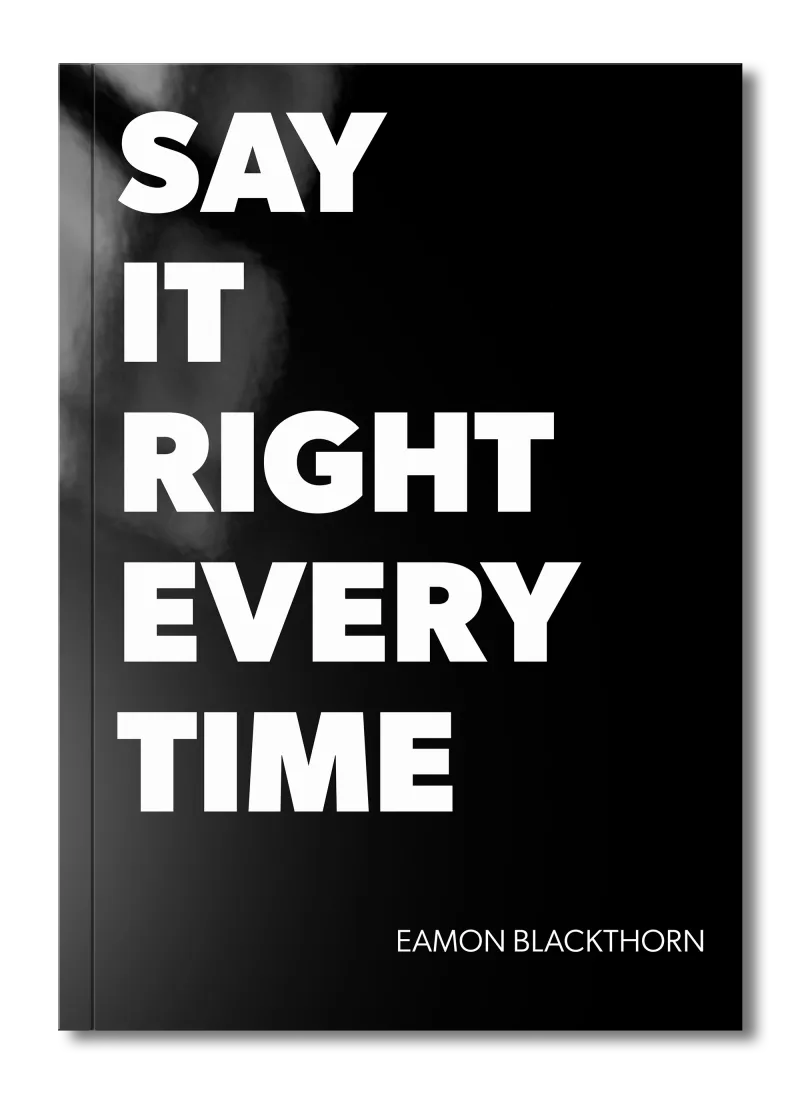
This is exactly the kind of scenario I break down in "Say It Right Every Time." The chapter on delivering feedback covers the difference between labeling someone's behavior and describing it, and why that single shift changes how the other person receives the message. If you manage people, that framework will change how you run every review you write from here on out.
Never Be Lost
for Words Again
Get word‑for‑word scripts for the conversations that shape your life, from job interviews and negotiations to difficult talks with family and partners, so you always know exactly what to say and how to say it.
Never Be Lost
for Words Again
Get word‑for‑word scripts for the conversations that shape your life, from job interviews and negotiations to difficult talks with family and partners, so you always know exactly what to say and how to say it.
Key Takeaway
Before you write your next performance evaluation, pull up the employee's calendar and project history from the past three months. Find two specific moments: one where they did something right, and one where they fell short. Write one sentence about each, naming exactly what happened and why it mattered. Those two sentences become the spine of the entire review.