

What Happened
Corporate governance experts are sounding the alarm: the way executives communicate is no longer just a professional nicety. It has become a material risk that boards, investors, and regulators now actively scrutinize. When leaders speak poorly, hedge publicly, or contradict themselves across stakeholder groups, the consequences show up in stock prices, regulatory scrutiny, and employee trust. This is a turning point in how leadership competence gets measured.
The Communication Angle
Let me put two executives side by side. Both face the same situation: a rough quarterly earnings call where the numbers missed Wall Street expectations. One executive walks in with a prepared statement full of passive voice, qualifiers, and corporate cushioning. "Results were impacted by headwinds we couldn't have fully anticipated." The other walks in and says: "We missed. Here is exactly why, here is what we are changing, and here is the timeline." Same bad news. Completely different signal to the market.
The first executive thinks he is being careful. He is not. He is being evasive, and experienced investors can smell evasion in under ten seconds. Passive voice is not protection. It is a red flag. It tells listeners that the person speaking either does not understand what happened or does not want to own it. Neither is acceptable at the C-suite level.
The second executive does something most leaders are terrified to do: he takes the problem out of the shadows and puts it on the table in plain language. This is called ownership framing. You name the failure before anyone else can name it for you. You define the narrative instead of letting analysts, journalists, or short-sellers define it for you. That is not weakness. That is control.
Here is the contrast that matters most. The hedger loses credibility twice: once when the bad news lands, and again when the market realizes he was not straight about it. The direct communicator loses credibility once, and then has a chance to rebuild it. That is a significantly better position, and it is entirely a communication choice.
Boards are now waking up to this. They are realizing that an executive who cannot speak clearly under pressure is a liability that belongs on a risk register, not just a performance review. This shift is overdue. Clear communication has always been a leadership function. The governance world is simply catching up to what good communicators already knew.
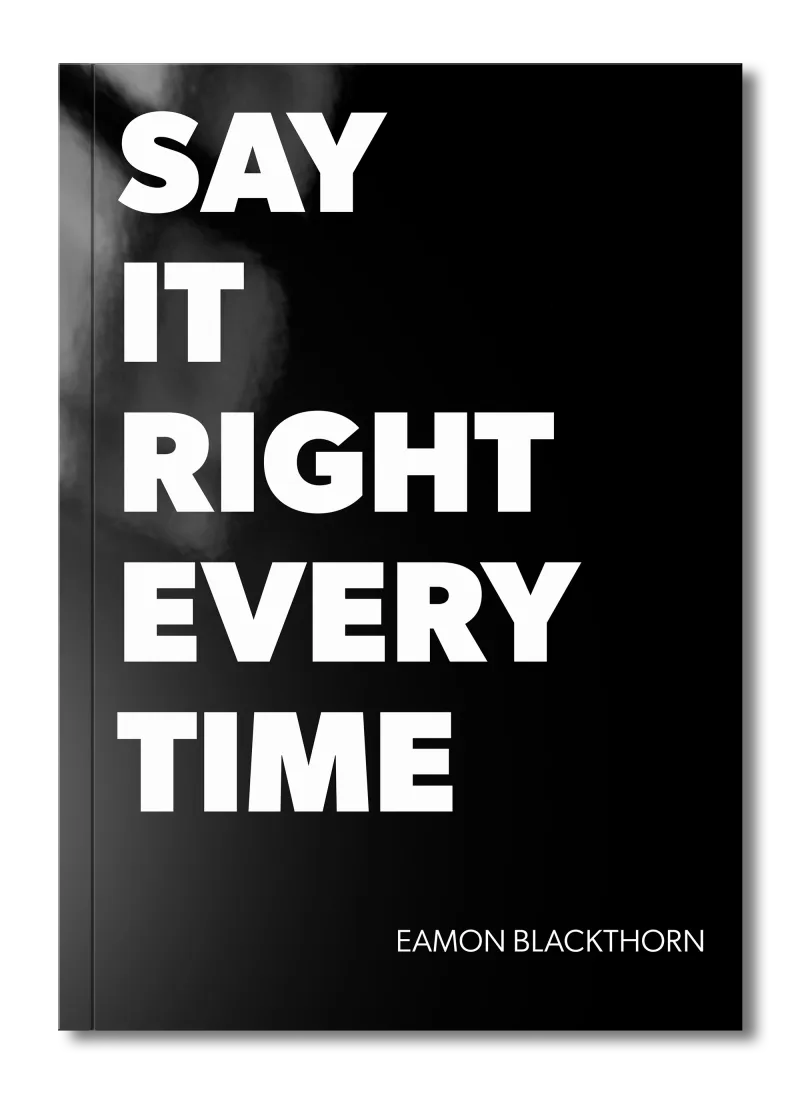
This is exactly the kind of scenario I break down in Say It Right Every Time. The chapter on high-stakes clarity gives you a framework for stripping a complex, pressure-filled message down to its essential core so that your audience hears exactly what you need them to hear, with no interference from hedging, jargon, or throat-clearing. It is the most practical tool I know for executives who need to perform under fire.
Never Be Lost
for Words Again
Get word‑for‑word scripts for the conversations that shape your life, from job interviews and negotiations to difficult talks with family and partners, so you always know exactly what to say and how to say it.
Never Be Lost
for Words Again
Get word‑for‑word scripts for the conversations that shape your life, from job interviews and negotiations to difficult talks with family and partners, so you always know exactly what to say and how to say it.
Key Takeaway
Before your next earnings call, investor update, or any high-stakes public statement, write one sentence that answers this question: "What is the one thing I want my audience to believe when this is over?" If you cannot write that sentence in plain language, you are not ready to speak. Build everything you say around making that one sentence true.