

What Happened
Boar's Head Brand's talent development director Ivan Gruenthal has spent nearly two decades building communication and leadership capability inside major corporations including SC Johnson and Kraft. His recent conversation with Infopro Learning focused on how organizations can train leaders to handle high-pressure, high-stakes conversations, the kind that determine promotions, resolve conflicts, and shape company culture, without those conversations falling apart before they start.
The Communication Angle
Picture this: a senior leader walks into a room to deliver difficult feedback to a high performer who is also a flight risk. The leader knows what needs to be said. The leader has rehearsed it. And then, the moment the conversation starts, he softens every edge, buries the main point in qualifications, and walks out thinking it went well. The employee walks out with no idea anything was wrong. Three months later, that employee is still doing the same thing, and the leader is still frustrated. This is not a rare situation. This is Tuesday inside most organizations.
The core problem with high-stakes conversations is not that leaders lack courage. It is that they lack a framework. Without one, the brain defaults to protection mode. You protect the relationship, you protect your image, you protect the other person's feelings. And in doing so, you protect the problem. It survives the conversation completely intact.
What Gruenthal and programs like the one he runs at Boar's Head understand is that you have to treat crucial conversations as a skill, not a personality trait. Some people are naturally direct. Most are not. That means training has to give people a repeatable structure: name the issue clearly, state the specific behavior (not the character flaw), describe the impact, and invite a response. In that order. Every time. The structure does the work so your nerves do not have to.
Here is what separates leaders who get results from those who get nodding heads and zero change: they separate the person from the problem out loud, not just in their heads. They say it in the room. "I'm not questioning your commitment, I'm pointing to this specific pattern." That one sentence changes the entire temperature of the conversation. It signals to the other person that you are not attacking them, you are solving something together.
The organizations that build this skill systematically, through blended learning, real practice, and reinforcement over time, are the ones that see it stick. A one-day workshop does not change how a nervous manager delivers a performance review. Repetition and feedback do.
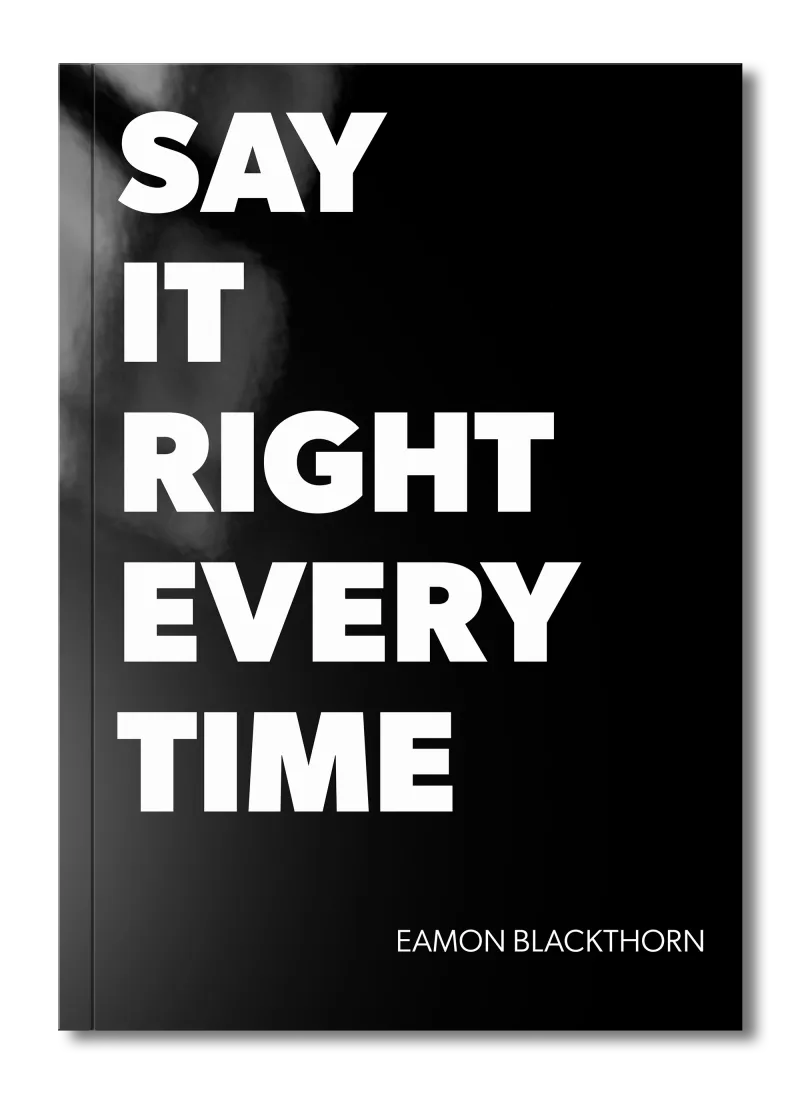
This is exactly the kind of scenario I break down in Say It Right Every Time. The chapter on high-pressure clarity gives you a framework for stripping a difficult message down to its three essential parts: the fact, the impact, and the ask. When leaders learn to deliver all three in under sixty seconds, without cushioning or circling, the conversation becomes something both people can actually work with.
Never Be Lost
for Words Again
Get word‑for‑word scripts for the conversations that shape your life, from job interviews and negotiations to difficult talks with family and partners, so you always know exactly what to say and how to say it.
Never Be Lost
for Words Again
Get word‑for‑word scripts for the conversations that shape your life, from job interviews and negotiations to difficult talks with family and partners, so you always know exactly what to say and how to say it.
Key Takeaway
Before your next difficult conversation, write down exactly one sentence that separates the person from the problem. Write it on paper before you walk in. Something like: "This is not about your value to the team, it is about this one specific behavior." Read it. Then say it in the first two minutes of the conversation. That single move will lower the other person's defenses faster than any amount of rapport-building small talk.